Showing posts with label coeliac. Show all posts

Tuesday, 9 August 2016

blue dragon red thai curry paste - food find


I heard about this via a vegan food page I subscribe to on Facebook. I’m not a vegan but contributors there regularly post stuff up that also happens to be gluten free. And it happens my partner, Sarah, is vegan so this made a handy addition to our camp cooking repertoire.

There are three pastes in the range, all vegan and all GF, the others are a green Thai and Massaman one. It was the latter I was keen on trying but was unable to find it, so opted for this.

I tend only to cook from scratch when car camping or on ‘Cheeky Overnighters’ where weight isn’t an issue. And it was on one of these that the paste made its way on to the menu.

The plan was to pre-pack rice noodles, a vegetable stock cube, cashew nuts, tamari, sesame oil, and grated coconut cream.  And then pick up some veggies along the way. As it happened we managed to find a ‘Chef’s Selection’ of baby corn, carrot, broccoli and mange tout which made the meal more authentic.

In a Snow Peak 1400 pot I heated the paste on a very low flame, this released the flavours but I was mindful to make sure it didn’t burn. A glug of sesame oil helped here. In went the stock cube, water, coconut, tamari and veggies. The latter I’d cut down into smaller bite size pieces. If I was cooking for one I’d have dropped the noodles in the pot too but I wasn’t, so I boiled some water in a Snow Peak 900 for the noodles whilst the curry sat in a cozy. The cashews nuts were added to it just before serving.

Juggling noodles indoors is a feat in itself and it takes on a whole new dimension when camping. But I managed the divvying up with the help of an Orikaso folding plate that clips together to form a bowl with a spout for draining stuff. The plate also doubled as a chopping board and somewhere to hold the veggies whilst I got the curry on the go.

The outcome? A very enjoyable meal. I’d certainly recommend this paste and will try the others when I’m able to track them down. Meat eaters could add fish sauce, of course, for that authentic umami taste that was obviously missing.

A couple of things to note. The Orikaso plates are no longer available in the version that I used. I carried the sesame oil and tamari in GSI condiment bottles. The Snow Peak pots nest even with the cozies on making for a compact modular cook system. I also own a 600 mug allowing me to scale the system down to a one person one.

Friday, 2 October 2015

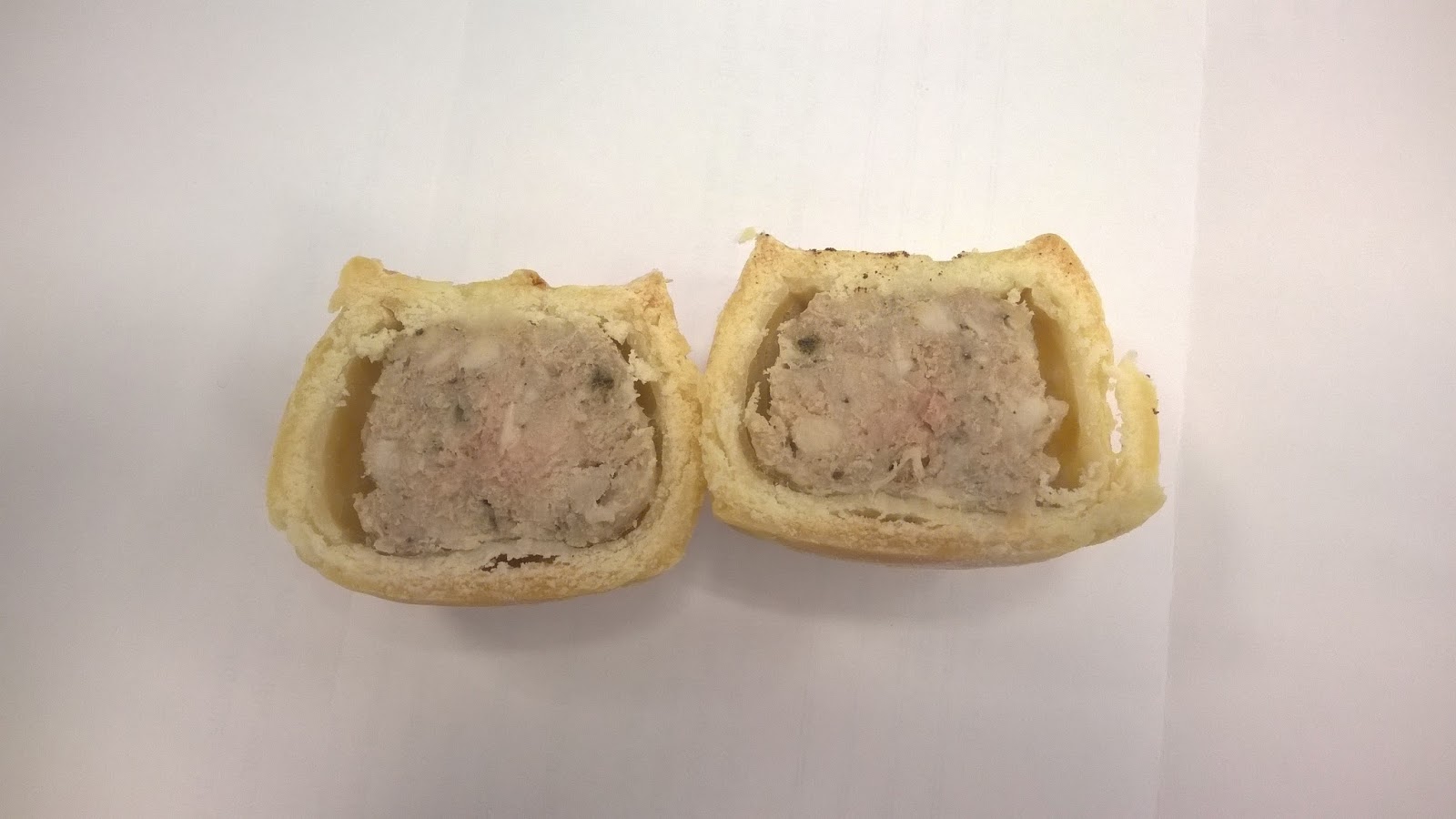
marks and sparks gluten free mini pork pies

A thin wash of glaze. 

A few months ago I discovered that M&S had started selling gluten free scotch eggs and they swiftly became the go-to day trip lunch item. At the time there was also some jokey dialogue going on a forum about what happened to those good old climbing/hiking food items like scotch eggs, pork pies and garibaldi biscuits. They had, for some, fallen out of fashion to ‘healthier’ options but for me the exclusion was a dietary one – I could no longer eat them.

Imagine my surprise and joy when I discovered that M&S are now doing pork pies and it goes without saying that I was scouting scotch eggs at the time, so grabbed a packet of these too.

A lack of jelly.

There are four mini pies in the pack weighing in at 50g each, and have the following food values 777KJ of energy, 12.3g fat, 14.3g of carbohydrate (CHO) and 4.5g of protein. And a pack of four cost circa £2.40. Being made from gluten free pastry I have to be forgiving, a bit, but I found the pastry a bit too dry. There didn’t seem to be sufficient fat content in the pastry to make the kind of crusty shell that pork pies are known for. There was an insufficient amount of glaze or lack of it on the pastry too. And the same can be said for the jelly which again is a key part of the pork pie experience. The first didn’t have any jelly and the remaining three had a small amount in the bottom of the pie with air space above. But not enough of it before it was lost. This is down to the fact that their size and the manufacturing process, no doubt. The filling again didn’t amount to much in volume but tasted well enough.

After the success of the scotch eggs I was disappointed by how these turned out. Personally I would rather have larger pies either 250g or even 500g sized ones that would have the space between the crust and filling for decent amount of jelly and would obviously contain an equally decent amount of meat too.

Sunday, 22 February 2015

gluten free scotch eggs - marks & spencer

Just before Christmas there was a tongue in cheek discussion on a Facebook outdoor page about trail food. One poster was bemoaning the fact that nobody seemed to eat the classic rucksack staples such as pork pies, Garibaldi biscuits, scotch eggs, malt loaf, etc these days. I joined the discussion stating that Garibaldi biscuits were a favourite of mine because they were very durable but these days due to having to follow a gluten free diet they were off menu. As were the rest of the other items under discussion for that matter.


Gone is sixty seconds

Not long after that I was looking for lunch in M&S and discovered that they now sell gluten free scotch eggs so they ended up in my basket in a flash. Back at the office they were gone before I could make note of the nutritional detail! And they were very tasty, a little drier than I'd like but that's gluten free food for you. A quick warm up would solve that but perfectly acceptable as a lunch when out and about. Since their discovery they have found their way in to my daypack on a number of occasions.

As you'd expect from a pork meat encrusted egg fat is high up on the count at 23g per egg (114g each approx) with protein at 13g and carbohydrate at 14g. As you can see with the amount of fat (20%) in it the scotch egg doesn't fit in today's ideal diet but if I'm out and about on the hills in winter these 'fat bombs.' are ideal for bolstering calorie intake, and are far more tastier than some alternatives. 


Thursday, 6 November 2014

kabuto gluten free rice noodles

There it was - gone!
I have fondness for oriental food so was happy to find these in my local Sainsbury’s. And sell for £2.00 per pot. There’s a small range of these (some with gluten in them) and the gluten free ones come in two flavours – chicken and miso. The chicken one is light and tasty with a bit of a chilli kick to it and the miso one is, well, savoury and salty as you would expect.

These make an ideal lunch or supper meal on the trail; one pot for lunch and I’d double up for supper. The miso one has 54.7g CHO and 261 calories. And there’s nothing to state that you can’t pimp the noodles with additional ingredients if you have them to hand, adding torn young nettle or dock leaves for example. On day hikes I wouldn’t bother to repackage but on longer trips I’d lose the cup and place the ingredients in a poly bag but remember make a note of how much water you need! With all these types of ‘instant’ noodles it’s just a matter of added the required amount of boiling water, stirring and leaving to stand for three minutes or so. I’d recommend giving them a stir a couple of times during that period because the first time I tried them some of the noodles were a bit chewy.

Wednesday, 22 October 2014

food find – nairn’s gluten free biscuit breaks


 Like the 9Bars that I blogged about here, these have become a lunchtime stable and have found their way into my rucksack.

There are three varieties but the two that I favour are the oat & syrup and chocolate chip. The four biscuit pouch has 188 calories and circa 24g of carbohydrate, the slight variation is because the choc chip ones have a little more CHO. And, of course, they are gluten free. The biscuits have a great crunch and texture with the oat & syrup winning on the latter. Although I’ve not tried it yet the oat & syrup ones would make a great crumble topping on some stewed apple, with some Bird’s Instant Custard on the side - yum!

Thursday, 20 March 2014

food find - 9bar


I’ve been packing these on day walks and trips since Autumn last year, and been using them as a lunchtime snack even when I’m not out and about.

The bars come in boxes of four, each bar weighs 40g and for that you get approx. 11g of carbohydrate, 7g of protein, and 924KJ of energy per bar. The bars are made from a seed mix with a carob topping. Currently on offer in Sainsbury’s at £3.00 for two boxes (usual price £1.89).

That’s the facts bit out of the way but you will already have noticed from my first paragraph that they’ve become a staple in my diet. There are several reasons for this; I like the taste and texture, the carbohydrate load is about right for me as a mid-morning blood sugar lifter, and the bars don’t contain oats. This later point is important. I’m allowed to eat oats but have to keep an eye on the amount I eat on a daily basis, so I can happily eat a couple of these a day without worry.


The only downside I can see is the stability of the carob topping in warmer weather, even at this time of year the topping has stuck to the wrapper a couple of times.

Wednesday, 25 September 2013

lentil and cheese slices

Lunch is served

It’s often a good thing to get a fresh pair of eyes on things. The subject of food is very close to my heart and a regular topic of conversation with others who have an interest in the same subject. Inevitably I’d end up quizzing people with what they pack for lunch.

The basis of my lunch is oatcakes along with pate or squeezy cheese, not exactly exciting fare but does the job especially when bolstered with the usual suspects such as dried fruit and nuts, fresh fruit, chocolate or cereal bars. On rare occasions, I’ll bake a gluten free flat bread flavoured with cheese, garlic and rosemary.

After a couple of trips, the oatcakes and mushroom pate had lost their appeal, and I was out of gluten free bread mix for making flat bread, so one of the group volunteered to make some lentil and cheese slices ‘for a change’. My first thought was, ‘What amount of carbohydrate (CHO) are these going to have?’ because although pulses are high in CHO not all of it can be digested. Her recipe, below, cunningly includes gluten free bread crumbs to increase the amount CHO. These will keep for a couple of days so make a great option for weekend trips. They don’t have to be an exclusive lunch item – I’d happily have a slice as part of breakfast or supper!

Lentil and cheese slices

225g split red lentils, rinsed
450ml water
1 onion
25g butter
100g strong cheddar
1 tsp mixed herbs
2 slices of gluten free bread
1 free range egg
Salt/pepper

Method

Cook the lentils in the measured water until soft and all the liquid has been absorbed. Chop the onion, then melt the butter in the saucepan and fry the onion until transparent. Combine all the ingredients together and press into an oiled 23cm swissroll tin. Bake in the oven at 190c for 30 minutes. Allow to cool and cut into wedges, wrap the wedges in foil, any that aren’t going into the rucksack can be frozen. 

Monday, 12 September 2011

helen browning's speedy sausages


These were suggested to me by a friend who also suffers from coeliac disease. Each packet has two portions of six sausages at 100g per portion, a handy size as part of a meal for one. The nutritional values are as follows; 1176KJ of energy, 17g of protein, 23g of fat, and a minuscule 0.6g of carbohydrate per portion.

The cooking instructions say they can be fried in a little oil in five minutes. As I wanted to simulate a camp cook scenario I set up my Coleman F1 lite on the patio and cooked them on a low gas with no oil in a non stick Primus fry pan. These are not called speedy for nothing and they were ready to eat in no time. I loved the taste of these although the fat content was a little high for my liking.


I've not tried any recipe ideas out yet but I guess they could be served with instant mash, with baked beans, or added to a rice or pasta dish. One of the dishes I've always wanted to re-create on a camp stove is Fabada. I can now envisage pre-diced chorizo being heated in a pan with the sausages until cooked through, chicken stock being added along with garlic granules, dried onion, and dried cooked cannelli beans. Then the seasoning; turmeric, smoked paprika, and ground pepper. The whole thing being brought to the boil and simmered, or put in a cosy, until the beans are reconstituted. I can't wait to give it a try.

Wednesday, 10 August 2011

mrs crimble's crackers


Finding a decent bread substitute for a backpacking lunch is a pain when on a gluten free (GF) diet. Doubly so because I'm a diabetic and need carbohydrate (CHO) to count against the insulin that I inject.

So lucky for me that I was approached by a PR company, The Ideas Network, who's client is Mrs Crimble's, and they sent me three boxes of cheese crackers to try. As it happens at the beginning of this week I was completing the last leg of the South Downs Way, and whilst in the general store in Alfriston I spotted a box of these crackers, so naturally I bought a box.

The three varieties are Original Cheese, Sundried Tomato and Pesto, and Rosemary and Onion, typical Mediterranean flavours then. Nutritionally they all contain 63.8% CHO however the flavoured crackers have few more calories than the plain ones. I like cheese flavoured biscuits because they can be eaten without any spread or topping, and, if you're lucky to have some, they go really well with sliced chorizo or salami.

Each box contains 7 servings of 4 crackers, giving 11.5g CHO per serving, so to suit my need I'd be looking at having a third of a box for lunch when out on the trail.

The crackers are very crisp, and like all gluten free biscuits and crackers they need careful packing because they will break up. Unsurprisingly it's because it's the gluten in wheat and other grains that hold bread, biscuits, etc together. Another point to note is that GF products are usually made from a mix of various starches, and potato starch likes absorbing moisture given any opportunity. Storage in an air tight container is a must, especially as the crackers aren't packed in portions. That said if there were two of you then sharing a box would solve that issue.

The flavouring isn't overpowering like some others I've tried. I'm always wary when food stuff has onion flavouring as usually several hours after eating I can still taste the onion, not so in this case. And I particularly like the crunchy crispness of the crackers.

I'm glad I was offered the opportunity to try these as they will help break up the monopoly that oat cakes have had on my lunch breaks.


Sunday, 31 July 2011

food find - asian home gourmet kimchi soup


Another great Longdan food find, Asian Home Gourmet Kimchi Soup paste. I've used this paste a number of times at home with the rice udon noodles that I posted about here. At home I added the paste to a litre of boiling water along with a roughly chopped onion and sliced bamboo shoots in the pot, after five or so minutes I added some cubed chicken breast. At this time the rice udon had been soaking for half an hour, and I'd refreshed the hot water during this time. Once the chicken had been poached I added shredded chard from the garden, and cooked for a further three or so minutes. The noodles were added to a (large!) bowl and the soup poured on top.

On the trail I'd use the broth I'd get from stirring the paste into hot water to rehydrate whatever I want to put in it. The choice is yours when it comes down to it but the paste isn't vegetarian as it contains shrimp paste and fish sauce. Soy sauce isn't used and the label states it's free of gluten contaminates, so it's gluten free but then I wouldn't be featuring it here if it wasn't! And it's MSG free too.

Stripped of the outer package the sachet weighs 53g,which isn't a bad weight compared to some cuppa soup mixes that might be used as a basis for a meal. And although the packet states use 500ml of water it does stretch to a litre as I use at home, so can be be split or used as a base for two in a larger pot.

This past week on a car camping trip I used the thick noodles again (I love them!) and poached chicken breast, pak choi, and bamboo shoots in the broth on a Trangia, the noodles needed breaking in half to soak but but nevertheless it was as good as ever (apart from trying to eat noodles with a spoon!)

I spotted some rice noodle nests that would make a great addition, albeit a bulky one, to this dish however whatever noodles you prefer, or can eat, this is a very flavoursome base and it''s one I'll continue to use.

Saturday, 16 July 2011

food find - rice udon


Longdan, an oriental supermarket chain, opened a store in town a few months ago and I wasted no time doing a supermarket sweep searching for stuff that would be suitable for backpacking (and my dietary needs, of course). Generally I steer clear of oriental food stuff because it invariably includes soy sauce or wheat noodles which contains gluten. However I am still fond of soupy noodle dishes so I was excited to find udon noodles made from rice. And, at the time, I thought that they would make a good addition to my backpack pantry.

For some reason there were no cooking instructions on the packet, this didn't matter I reasoned, I'll just cook them like I would gluten free pasta... However my first attempt resulted in half cooked noodles in very gloopy water! After scouring the Internet, including having to translate various pages, I was still no wiser. A quick visit to the shop and I discovered from another manufacturer of fat noodles that they need to be soaked in 'warm' water for twenty minutes or until soft. Back in the kitchen I soaked the second batch in hot water, and the noodles took nearly forty minutes to soften up.

Sadly although I've enjoyed a number of great dishes with these lovely fat noodles the preparation time discounts them from being useful on backpacking trips for me. If you're prepared for the wait, or like some, who carry nalgene flasks to rehydrate food stuff and can't eat food with gluten in, then give them a go. There's always the opportunity however, depending what's in my store cupboard, I might prepare them at home for an overnighter perhaps and carry them in a ziplock bag.

Wednesday, 6 July 2011

gefen gluten free thin noodles


A seasonal food find as I found out when I went back to Sainsbury's. These were only stocked for Pesach (passover). And despite spending some time online I haven't been able to find a supplier, which is a shame as only having a single box to test a recipe is limiting.

My aim was to create a backpackers version of chicken noodle soup or lokshen as I remember it being being called when I was younger. My mother always used to administer this whenever a family member was ill. It's not a cure but, like all soups, it's a comfort food, it's easy to swallow, it helps rehydrate, and delivers calories thus helping the body to recover. So therefore ideal at the end of a long, hard day on the trail.

My memory of the dish was that it was thin like a consomme but I wanted to make it more harty, making sure that it had a good quantity of CHO ( carbohydrate) and therefore calories. One thing I do when building recipes is to work out how much CHO there is in the ingredient so I know how much insulin I will need. Unfortunately the nutrition facts panel is a bit confusing; it seems to imply that a single serving of 56g contains 82g of CHO! Although this may be based on the cooked weight, using 56g of dry ingredients. Looking at the 340 calories per serving, and with CHO having 4 calories per gram this would indicate again that there is 80g or so of CHO. I guess this must support my thinking that this is cooked weight. Why they cant just stick to using dry weight facts I don't know, I've come across this before with other dried foods, and it makes calculating how many insulin units I need difficult. Back to the recipe idea...

The base must be of good chicken stock so I always use Kallo low sodium and free range chicken stock cubes, one of each in this case. Apart from the noodles, I'm going to add some dried onion, dried garlic granules, diced dried carrot and swede, and some dried herbs. And if I have some shredded dehydrated chicken. The noodles take three minutes to cook, so it's important for the other ingredients to be hydrated before the noodles go in the pot. That's the idea, and I'll update once I've had a few attempts.

Thursday, 20 January 2011

the outdoor show

The 2011 show was held in London for the first time, relocating from Birmingham NEC to ExCel in the docklands. And similar to other events (TFM and the Publishing Expo being another example) this was club sandwiched with the London Bike Show and the London International Boat Show.

The show at it’s previous location wasn’t of any interest to me, not least that I’ve always felt the exhibitors list wanting. And looking at this year list I wasn’t expecting much.

That said I’d been sent some complimentary tickets, Ben was over so it was a good excuse for a trip up to town. And across it, and out the other side; ExCel is the other side of the Isle of Dogs.

It was certainly busy and we wandered around looking at stands but not seeing very much, a friend who had visited the show earlier in the week bemoaned a ‘lack of gear and gadgity things…’ I can only agree.

I had an interesting chat with a couple on the Tick Awareness Stand, one of whom had contracted Lyme Disease from a tick bite. Changes in farming methods, and the increase in the number of people enjoying the outdoors has lead to an increase in the number of cases.

And on one other stand, someone committed the cardinal sin of not knowing the product they manufacture, even with a laptop connected to their website he wasn’t able to answer my question. I’ll spare them any blushes by not naming them. But suffice to state that if you manufacture freeze dried meals and have a stand at a show like this punters are going ask whether the food contains gluten or any of the other allergens. Not having an answer cost them a customer and any glowing reviews that I might have written.

For my part the small but cosy collection of stands at the BPC AGM is the best place for gear and gadgity things. Now if someone could persuade Henry Shires, Ron Bell and other cottage industry manufacturers to fly over with kitbags of their goodies then that would be, well, brilliant…

Thursday, 28 January 2010

polenta

Given that I have to follow a gluten free diet you would have thought that I’d be cooking up polenta dishes on backpacking trips. I’ve side stepped using the stuff because my experience of cooking polenta indoors. I thought the need to pour a stream of the grain whilst stirring frantically to prevent lumps, then the volcanic activity of the polenta, and more frantic stirring would be too much of a faff on a campsite. Especially after a tiring day.

At the weekend I found some instant, one minute cook to be precise, polenta that just needs stirring into boiling water and paddled about for 60 seconds. In fact on my first try this lunchtime once I’d stirred the grain in the pot went straight into a pot cosy avoiding any volcanic eruptions. Lump prevention happened as I mixed the recipe in a poly bag, and cutting the corner off the bag I was able to trickle it without much fuss.

Recipe

75g instant polenta
3 sun dried tomatoes, cut into slithers
11/2 tsp of Italian herb mix
pepper
20g grated parmesan cheese

The first four ingredients were blended in a bag, and the cheese was added after the polenta was cooked. The packet suggested I use 100ml of water per 25g polenta and that gave the right kind of consistency. And 75g is enough for lunch with about the same amount of carbohydrate as four slices of bread. For an evening meal I’d up the quantity to 100g or even 125g.

As polenta is fairly bland it’s worth experimenting; cubed smoked cheese, chicken, bacon or salami could all be added to bump up the flavour, calories and protein.

Sunday, 17 January 2010

pack food weight

Generally on short trips I don’t bother with dehydrated meals for supper. I prefer to take one of those ‘instant’ pouch rice meals that can be reheated in a couple of minutes. As was the case for the aborted Buxton trip. One thing I’d never done was weigh the food. A few years ago, I loosely calculated that I carry 750g of food per day. A figure not dissimilar to the one, then quoted in imperial weight, in Derrick Booth’s The Backpackers Handbook which I was happy with.

Having diabetes and coeliac I err on the side of caution when it comes to packing food, the extra weight of which I never begrudgingly carried. It was something of a surprise that when I put the food bag on the scales two days supply shipped in at 866g per day, a little over 100g more that my estimated weight. Taking into account that one of the suppers comprised a rice pouch with a single serve tuna pouch, in the original packaging. And that I also had a tube of mushroom pate in the bag which will last about four days, the figure that I calculated was not far off if I used home dried meals.

I’d like to reduce the weight but am resigned that I need the extra provisions as picking food up along a trail that I can use is a bonus and not something that I can rely on.

Saturday, 19 September 2009

gluten free bannock

Success! I've just used Doves Farm gluten free self raising flour to make the best bannock bread yet. I followed Liam's approach for his rum and raisin bannock.

Three parts flour
One part dried milk powder
One teaspoon allspice
One teaspoon cinnamon
Two teaspoons of minced raisins
A dash of sunflower oil

I mixed the above with enough water to make a thick batter, and dropped a tablespoon of the mixture into the pan. I flipped the bread over once the underside was done and continued cooking until it sounds hollow when tapped with the spoon. Unfortunately I didn't have any rum knocking around the house but the result was delicious all the same! The above quantity will make two breads.

Monday, 31 August 2009

gluten free bannock bread

My on going search for a suitable piece of cooking kit to make pan bread may have come to an end. Whilst out and about in Guildford I popped into Lakeland to buy some zip lock bags and found a mini non-stick bake tray. And for a little more than three quid it was worth a gamble.

To test the tray I mixed the following;

Three parts gram flour
One part polenta
One teaspoon of baking powder
A few raisins
A sprinkling of brown sugar
One teaspoon of ground cinnamon
One part oil

I added water little by little stirring until I had a smooth batter.

The tray was placed on the Coleman F1 Lite stove which was then lit and held on a very low flame. It didn't take long for the tray to heat up and I dropped a tablespoon of the batter in the middle of the tray. After a few minutes holes started to appear in the bread at this point I flipped it over and let it cook for another few minutes.

The result was very tasty. And not really bannock bread but a cinnamon and raisin drop scone in fact.

Will the idea work on the trail? The baking tray is heavy at nearly 200g and it needs a pot holder. The dry ingredients can be mixed at home and made into a batter by adding water to the bag and massaging it. And keeping a low flame on the stove may be difficult in windy weather. Another consideration is the stove, the F1 Lite is a very efficient burner, so the lazier flame of a Gnome might be a better option. I'd like to tinker around with different flour mixes and flavourings too.